LATVIJA.FM
Sukubs No. 6: Riga’s Cubist Café Where Artists Designed the Furniture and the Future
In 1919, above Merķeļa Street opposite Vērmanes Garden, Riga acquired a café unlike anything its public had seen before. Sukubs No. 6 served inexpensive vegetarian food, but its real distinction was visual: young modernists painted the walls, Romans Suta designed furniture, and artists, writers, actors, and critics gathered beneath radical Cubist and Suprematist forms. The café became an informal headquarters of Latvia’s emerging modernism, a place where new art was not confined to galleries but entered daily life, conversation, meals, and even weddings.
A Vegetarian Café Opposite Vērmanes Garden
Sukubs began in July 1919 as a practical business run by Natālija Suta, the mother of painter Romans Suta. She opened the café and dining room at Pauluči Street 21, today Merķeļa Street, in a second-floor apartment overlooking Vērmanes Garden. Natālija had studied cooking in Berlin before the First World War, and her establishment was known especially for inexpensive vegetarian dishes: cabbage cutlets, vegetable schnitzels, casseroles, sauces, porridges, compotes, tea, and coffee. Meat could apparently be provided on request, but alcohol was not part of the normal offering. She also ran housekeeping and cookery courses on the premises, with students helping in the café. That combination of ordinary food service and experimental art was central to Sukubs from the beginning. It was accessible enough for young artists with limited means, and Natālija was remembered as willing to extend credit. Instead of an exclusive salon, Riga’s most radical artistic meeting place developed inside a modest, functioning eating house where one could discuss a new visual language over a simple meal.
Why It Was Called Sukubs
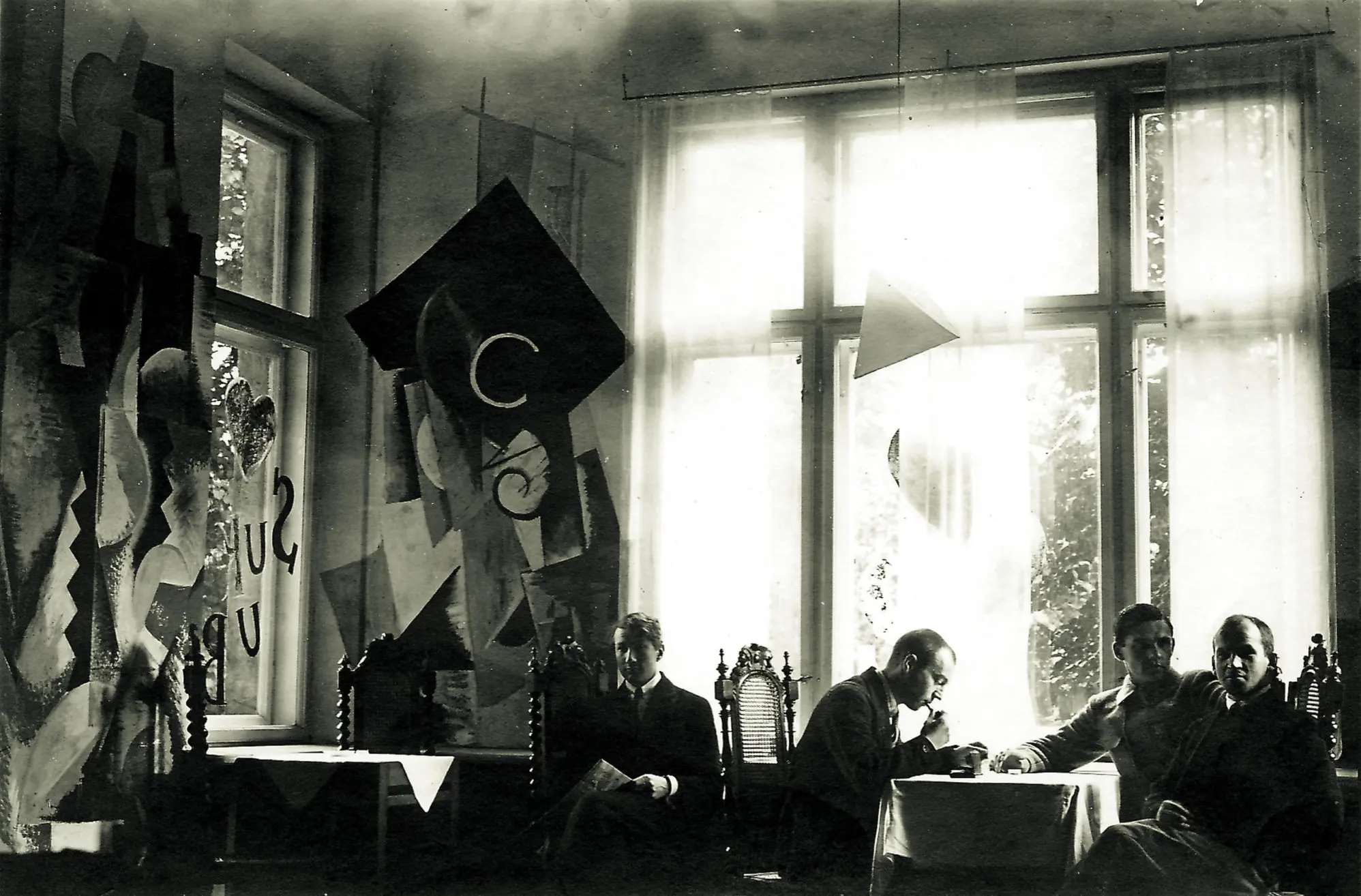
The café’s strange name announced its artistic intentions before a visitor even entered. Sukubs was formed from two avant-garde terms then important to Riga’s young modernists: Suprematism and Cubism. The establishment was advertised as Sukub Nr. 6, a name already familiar enough by August 1919 to become the subject of newspaper satire. Inside, six young artists were associated with its modernist decoration: Romans Suta, Aleksandra Beļcova, Oto Skulme, Niklāvs Strunke, Valdemārs Tone, and Konrāds Ubāns. Suta, Skulme, Strunke, Tone, and Ubāns painted directly on the walls, while Beļcova’s works were mounted separately and she was also responsible for the corridor arrangement. Contemporary descriptions stressed how completely the surfaces were transformed. Walls became large compositions of intersecting planes, geometric shapes, strong contrasts, and deliberately unfamiliar forms. Sukubs therefore functioned as an interior-sized modernist artwork rather than a conventional café decorated with a few paintings. Visitors encountered the new art simply by entering, sitting down, and looking around them.
When Furniture Became Part of the Modernist Experiment
The interior mattered because Latvia’s young modernists were trying to move beyond the expectation that serious art belonged only on a framed canvas. Romans Suta was especially interested in applying modern design principles to everyday surroundings. For Sukubs he designed simple, practical furniture with clear forms rather than ornate historical decoration, while the wider interior joined furnishings, painted walls, corridor design, signage, and graphic identity into one environment. This was consistent with Suta’s broader interest in interior design and applied art, where he often tried to translate contemporary European ideas into forms suited to Latvian life. At Sukubs, modernism became part of an ordinary usable interior rather than something encountered only at an exhibition. Aleksandra Beļcova later added decorative panels whose overlapping planes and collage-like construction became important examples of Latvian classical modernism. The café consequently anticipated a principle increasingly important in twentieth-century design: painting, furniture, graphics, and architecture did not need to exist as isolated disciplines. Even a small commercial interior could become a coordinated experiment in how modern visual culture should look and function.
The Walls That Started an Argument
The paintings did not produce quiet admiration. They produced confusion, jokes, arguments, and exactly the kind of public attention the young artists needed. A particularly revealing response appeared in Latvijas Sargs on 19 August 1919, only weeks after the café opened. Writing under the name Ludvigs Šanteklērs, Mārtiņš Gailis humorously described visitors attempting to guess what the strange forms on the walls represented. Different observers imagined everything from literary forms to maritime scenes, markets, and bizarre interiors. When the writer sought explanations from the artists themselves, he received little help. The article ended by predicting future “art wars” when these painters eventually organized an exhibition. The joke captured a real cultural transition: many Riga viewers were being confronted with a visual language for which ordinary realism provided no useful key. Sukubs made that confrontation immediate. One did not need to deliberately visit an avant-garde exhibition; the argument was happening in a café. Over time, such encounters helped make Cubist and related modernist approaches part of Riga’s cultural vocabulary rather than an abstract foreign phenomenon.
The Meeting Room of Riga’s Young Modernists
Sukubs was important not only because of what covered its walls, but because of who repeatedly sat between them. The young painters who formed the Expressionist Group in 1919 and renamed it the Riga Artists Group in 1920 used the café as a regular gathering place. Romans Suta, Niklāvs Strunke, Valdemārs Tone, Jēkabs Kazaks, Konrāds Ubāns, Oto Skulme, and their colleagues discussed exhibitions, artistic principles, and organizational plans there. Photographs preserved by the Latvian National Museum of Art show members of the group gathered in the café around 1920, turning an otherwise temporary social setting into part of the visual record of Latvian modernism. Ideas for the group’s activities and its first exhibition were developed in Sukubs, and formal meetings were also held there and recorded. The clientele extended well beyond painters. Writers, actors, sculptors, and critics came regularly, including Jānis Sudrabkalns, Pāvils Rozītis, Jānis Akuraters, Edvarts Virza, Kārlis Zāle, Sigismunds Vidbergs, and others. The café became a working cultural network rather than simply a fashionable place to be seen.
Bohemian Riga Without the Expected Alcohol
For all its reputation as a centre of bohemian Riga, Sukubs does not fit the usual image of a smoky, alcohol-driven artists’ café. Its kitchen was largely vegetarian and its drinks were coffee, tea, and compotes. That difference did not make the social life subdued. Public discussions were fashionable, and Sukubs hosted debates on art and other questions of contemporary life. Poet Jānis Sudrabkalns, who published under the name Olivereto, even turned the café’s culture of argument into verse. Family occasions also became part of the place’s history. When Romans Suta and Aleksandra Beļcova married in 1922, their wedding celebration was held at Sukubs. Their daughter Tatjana Suta later remembered dancing in its corridor beside large mirrors. The café was also connected with the creation of the satirical magazine Ho-Ho, in which writers supplied texts and artists supplied caricatures. This mixture of professional collaboration and private life explains why Sukubs became more than an address. The same rooms could contain a meal, an artistic dispute, editorial work, a group meeting, or a wedding celebration, often involving the same closely connected circle.
What Remains of Sukubs Today
By the end of the 1920s, Sukubs had lost much of its earlier role as the daily centre of Riga’s young modernist circle. Careers developed, families grew, artistic associations changed, and the intense concentration of personalities that had made the café so influential gradually dispersed. The original interior did not survive intact, but enough evidence remains to reconstruct its importance. Photographs preserve the painted rooms and the artists who occupied them. Aleksandra Beļcova’s decorative work survives in museum collections, and a coat rack that once stood in the café can still be seen in the Romans Suta and Aleksandra Beļcova Museum in Riga. The museum archive also preserves photographs documenting wall paintings, furnishings, and the people who gathered there. What survives most clearly is Sukubs’ demonstration that Latvian modernism was not created only in studios and exhibition halls. It developed through conversation, friendship, argument, practical design, food, and shared urban space. Sukubs No. 6 remains important because its artists applied their ideas to an entire environment, turning an ordinary Riga café into one of the defining places of early Latvian modernism.
Sukubs began in July 1919 as a practical business run by Natālija Suta, the mother of painter Romans Suta. She opened the café and dining room at Pauluči Street 21, today Merķeļa Street, in a second-floor apartment overlooking Vērmanes Garden. Natālija had studied cooking in Berlin before the First World War, and her establishment was known especially for inexpensive vegetarian dishes: cabbage cutlets, vegetable schnitzels, casseroles, sauces, porridges, compotes, tea, and coffee. Meat could apparently be provided on request, but alcohol was not part of the normal offering. She also ran housekeeping and cookery courses on the premises, with students helping in the café. That combination of ordinary food service and experimental art was central to Sukubs from the beginning. It was accessible enough for young artists with limited means, and Natālija was remembered as willing to extend credit. Instead of an exclusive salon, Riga’s most radical artistic meeting place developed inside a modest, functioning eating house where one could discuss a new visual language over a simple meal.
Why It Was Called Sukubs
The café’s strange name announced its artistic intentions before a visitor even entered. Sukubs was formed from two avant-garde terms then important to Riga’s young modernists: Suprematism and Cubism. The establishment was advertised as Sukub Nr. 6, a name already familiar enough by August 1919 to become the subject of newspaper satire. Inside, six young artists were associated with its modernist decoration: Romans Suta, Aleksandra Beļcova, Oto Skulme, Niklāvs Strunke, Valdemārs Tone, and Konrāds Ubāns. Suta, Skulme, Strunke, Tone, and Ubāns painted directly on the walls, while Beļcova’s works were mounted separately and she was also responsible for the corridor arrangement. Contemporary descriptions stressed how completely the surfaces were transformed. Walls became large compositions of intersecting planes, geometric shapes, strong contrasts, and deliberately unfamiliar forms. Sukubs therefore functioned as an interior-sized modernist artwork rather than a conventional café decorated with a few paintings. Visitors encountered the new art simply by entering, sitting down, and looking around them.
When Furniture Became Part of the Modernist Experiment
The interior mattered because Latvia’s young modernists were trying to move beyond the expectation that serious art belonged only on a framed canvas. Romans Suta was especially interested in applying modern design principles to everyday surroundings. For Sukubs he designed simple, practical furniture with clear forms rather than ornate historical decoration, while the wider interior joined furnishings, painted walls, corridor design, signage, and graphic identity into one environment. This was consistent with Suta’s broader interest in interior design and applied art, where he often tried to translate contemporary European ideas into forms suited to Latvian life. At Sukubs, modernism became part of an ordinary usable interior rather than something encountered only at an exhibition. Aleksandra Beļcova later added decorative panels whose overlapping planes and collage-like construction became important examples of Latvian classical modernism. The café consequently anticipated a principle increasingly important in twentieth-century design: painting, furniture, graphics, and architecture did not need to exist as isolated disciplines. Even a small commercial interior could become a coordinated experiment in how modern visual culture should look and function.
The Walls That Started an Argument
The paintings did not produce quiet admiration. They produced confusion, jokes, arguments, and exactly the kind of public attention the young artists needed. A particularly revealing response appeared in Latvijas Sargs on 19 August 1919, only weeks after the café opened. Writing under the name Ludvigs Šanteklērs, Mārtiņš Gailis humorously described visitors attempting to guess what the strange forms on the walls represented. Different observers imagined everything from literary forms to maritime scenes, markets, and bizarre interiors. When the writer sought explanations from the artists themselves, he received little help. The article ended by predicting future “art wars” when these painters eventually organized an exhibition. The joke captured a real cultural transition: many Riga viewers were being confronted with a visual language for which ordinary realism provided no useful key. Sukubs made that confrontation immediate. One did not need to deliberately visit an avant-garde exhibition; the argument was happening in a café. Over time, such encounters helped make Cubist and related modernist approaches part of Riga’s cultural vocabulary rather than an abstract foreign phenomenon.
The Meeting Room of Riga’s Young Modernists
Sukubs was important not only because of what covered its walls, but because of who repeatedly sat between them. The young painters who formed the Expressionist Group in 1919 and renamed it the Riga Artists Group in 1920 used the café as a regular gathering place. Romans Suta, Niklāvs Strunke, Valdemārs Tone, Jēkabs Kazaks, Konrāds Ubāns, Oto Skulme, and their colleagues discussed exhibitions, artistic principles, and organizational plans there. Photographs preserved by the Latvian National Museum of Art show members of the group gathered in the café around 1920, turning an otherwise temporary social setting into part of the visual record of Latvian modernism. Ideas for the group’s activities and its first exhibition were developed in Sukubs, and formal meetings were also held there and recorded. The clientele extended well beyond painters. Writers, actors, sculptors, and critics came regularly, including Jānis Sudrabkalns, Pāvils Rozītis, Jānis Akuraters, Edvarts Virza, Kārlis Zāle, Sigismunds Vidbergs, and others. The café became a working cultural network rather than simply a fashionable place to be seen.
Bohemian Riga Without the Expected Alcohol
For all its reputation as a centre of bohemian Riga, Sukubs does not fit the usual image of a smoky, alcohol-driven artists’ café. Its kitchen was largely vegetarian and its drinks were coffee, tea, and compotes. That difference did not make the social life subdued. Public discussions were fashionable, and Sukubs hosted debates on art and other questions of contemporary life. Poet Jānis Sudrabkalns, who published under the name Olivereto, even turned the café’s culture of argument into verse. Family occasions also became part of the place’s history. When Romans Suta and Aleksandra Beļcova married in 1922, their wedding celebration was held at Sukubs. Their daughter Tatjana Suta later remembered dancing in its corridor beside large mirrors. The café was also connected with the creation of the satirical magazine Ho-Ho, in which writers supplied texts and artists supplied caricatures. This mixture of professional collaboration and private life explains why Sukubs became more than an address. The same rooms could contain a meal, an artistic dispute, editorial work, a group meeting, or a wedding celebration, often involving the same closely connected circle.
What Remains of Sukubs Today
By the end of the 1920s, Sukubs had lost much of its earlier role as the daily centre of Riga’s young modernist circle. Careers developed, families grew, artistic associations changed, and the intense concentration of personalities that had made the café so influential gradually dispersed. The original interior did not survive intact, but enough evidence remains to reconstruct its importance. Photographs preserve the painted rooms and the artists who occupied them. Aleksandra Beļcova’s decorative work survives in museum collections, and a coat rack that once stood in the café can still be seen in the Romans Suta and Aleksandra Beļcova Museum in Riga. The museum archive also preserves photographs documenting wall paintings, furnishings, and the people who gathered there. What survives most clearly is Sukubs’ demonstration that Latvian modernism was not created only in studios and exhibition halls. It developed through conversation, friendship, argument, practical design, food, and shared urban space. Sukubs No. 6 remains important because its artists applied their ideas to an entire environment, turning an ordinary Riga café into one of the defining places of early Latvian modernism.
Cover image: Riga Artists’ Group members at the Sukubs café, 1920. From left: Valdemārs Tone, Niklāvs Strunke, Oto Skulme and Romans Suta. Photographer unknown. Collection of the Romans Suta and Aleksandra Beļcova Museum, Latvian National Museum of Art, inv. no. SBmuz SB/D-169. Source.
This photograph was colorized by Latvija.fm using a historically informed and deliberately restrained approach. We believe such colorization can improve visual clarity, bring out details that are less apparent in black and white, and reduce the distance of time between the modern viewer and the people depicted. When done carefully, it helps the viewer engage more directly with the image and better imagine the world as it may have appeared to contemporaries.
This photograph was colorized by Latvija.fm using a historically informed and deliberately restrained approach. We believe such colorization can improve visual clarity, bring out details that are less apparent in black and white, and reduce the distance of time between the modern viewer and the people depicted. When done carefully, it helps the viewer engage more directly with the image and better imagine the world as it may have appeared to contemporaries.